FAQ
Everywhere we travel, people ask many of the same questions about the Parenting With Dignity® program, our backgrounds, our qualifications, what to expect from our program, and a host of other matters. On this page, we answer those frequently asked questions with in-depth responses. If you have a question that is not covered on this page, please let us know.
Questions
Answers
What is the Parenting With Dignity® program?
Our program is presented as a 9 hour parenting course offered on DVD or VHS video with a FREE accompanying parent's workbook. The premise of our program is based upon one central idea:
"WHETHER YOU APPROVE OR NOT, YOUR CHILDREN WILL MAKE
ALL OF THE BIG DECISIONS IN THEIR LIVES; SO, OUR ONLY HOPE
IS TO TEACH THEM HOW TO MAKE GOOD DECISIONS."
The course is intended to be viewed by parents over a nine week period of time (to see the individual lessons, click here). It consists of approximately nine hours of video classes, and we feel strongly that they produce the best results when viewed in small groups. Each tape is designed to be viewed in sequence, although if viewed alone, every lesson will teach the viewer new skills which can be used immediately in dealing with children. Also, included in the package is a Facilitator's tape which contains many suggestions for attracting class members, and setting up and conducting classes! To order the videos, click here.
Top
Where does the phrase "Parenting With Dignity" come from?
When I (Mac Bledsoe) was in the Army there was an amazing lady who worked for me in the office that I was assigned to manage. I'll call her Patricia to keep her identity private, but Patricia kept me sane while I was in the insanity of the Army and the Viet Nam war. She also taught me a ton while I was there. (She remains a friend today and she is still teaching me.) One day she was out in the reception center greeting soldiers with her usual cheerful attitude and she was treating everyone with the same respect and dignity... rank, age, color or position never made any difference to Patricia . She treated everyone with dignity and integrity. I could see her through the window in my office. She had arrived at her usual time, ten minutes early. After about an hour on the job one of the Privates who worked with her came in and said, "Lt. Bledsoe, did you see what happened to Patricia last night?"
"No," I replied.
He just dropped the Newspaper on my desk and left. On the front page of the paper was a picture of Patricia's home... and there was a ten-foot cross burning in her front yard! It was a time of great racial strife in our country, back in 1969, and the Ku Klux Klan was very evident in our area at that time because of government enforced school integration. I don't remember all of the particulars but the cross burning had to do with a marriage that was to happen in Patricia's family which didn't meet with the KKK's approval or something like that. Patricia is black and I think that one of her relatives was marrying a person who appeared to be of lighter skin or something of equally insane nature. The fact was, Patricia had suffered a terrible and frightening indignity the night before.
I looked out my window and there was Patricia , calm and cheerful, as ever, even though it was common knowledge that the Sergeant seated two desks from Patricia was a high-ranking officer in the local KKK. I was dumbfounded and confused so I went and called Patricia into my office. I pointed at the paper on my desk and said, "I just learned about what happened at your house last night, and Patricia you have to help me because I don't understand something. How can you be on time to work and cheerful, respectful, and kind to everyone after something so terrible has happened to you?"
She reached across my desk in that amazing and instructive manner of hers, patted my hand, and said, "Oh, Lt. Bledsoe, that is easy. In our family we are respectful and dignified, not necessarily because the people around us are acting respectable nor dignified... we act that way because we are!"
Gulp! My life was changed forever! Patricia had just proposed a concept to me that was a standard from me to strive to reach for the rest of my life! In all situations I get to choose the manner in which I deal with other people. Their actions do not dictate my response, I do. When we began to develop our parenting curriculum I felt that it was only fitting to title it Parenting with Dignity because in our way of looking at it, parenting requires the kind of same self-control. The parent must be dignified in the response to the child even though the child may be acting rather undignified, lying there in the entrance to the super market kicking and screaming!
Top
Why does your experience in raising Drew make you authorities capable of speaking about effective parenting?
The answer to that is simple, it does not! Just because Drew is a good football player does in no way qualify us to speak authoritatively about parenting skills. Shoot, we made most of the mistakes we learned from with Drew! Our kids were easy children to raise but in the process of raising Drew and Adam we did a ton of reading and paying attention. We were fortunate to both be schoolteachers and we paid attention to what the kids in our classes taught us. The resources we used in the creation of our curriculum were the children in our classes. We worked hard to use tactics that worked and we paid attention to the results. Certainly we have read extensively and have attended countless workshops, and conferences but our chief source of information came from our work in the real world with real kids, real parents, and real problems. Believe me, I am as aware as anyone that in some circles some people discount any conclusion about human interaction that is not backed up by extensive clinical and laboratory research. However, we tend to put much more stock in the practical and time-tested skills that we have actually used in real life situations. We have studied the tactics of effective work with kids for longer that most researchers at colleges, universities, and research institutes. We have worked with literally thousands of subjects over a combined 46 years of teaching. Our observations do count for something.
Forgive me for this but I really do not much care what the world of academia thinks of what we teach in our Parenting with Dignity Program. I am only concerned about what the people we are attempting to help can understand and use. Unfortunately, much of the information which is "supported by solid empirical findings showing their effectiveness" are locked away, in educational, psychological, and medical journals rather than in the homes of the people who need them. I have 29 years of experience in the public school classrooms. My wife, Barbara, has 17 years of experience. What we have designed for parents is a set of skills that we found to work with kids. We make no pretence that what we know about what works was gained through "empirical research." It does not have to come from a lab or clinical research to work for us or to work for parents.
This program does not pretend to be "rocket science or brain surgery!" The name for our program is a case in point. We call it Parenting with Dignity because we learned a very simple principle from an amazing lady in Virginia. She was the victim of hatred and terror perpetrated by the Ku Klux Klan when they burned a cross in her front yard but she still showed up for work on time and still treated everyone with kindness, respect, and dignity. When I asked her to explain how she could be so constant in her calm care for others even in light of the nastiness and racial prejudice she experienced on the previous evening. She responded very simply, and cheerfully, "Oh, that's simple, Mac. In our family we treat people with respect, kindness, and dignity, not because others happen to treat us with respect, kindness, and dignity. We treat them that way because WE are respectful, kind, and dignified!"
Her simple statement of an obvious truth about human interaction seemed to stand on its own simple validity. We did not feel that it required empirical research to be used by us and other parents in dealing with our kids. We used her simply stated truth to say to ourselves, "We will treat children with respect, kindness, and dignity, and we will do it not necessarily because they are acting that way but rather because we are." This concept has served countless thousands of parents we have worked with to control their anger or frustration with their children and be the adult in the situation and continue to treat their children with dignity. Simple but true!
We also found out by personal experience that we could drastically increase the chances of getting a child or room full of children to do what we were trying to get them to do if we could actually tell them what it was! We found out that the chances of getting the children to what we were instructing them to do were significantly increased if we could explain the desired action in behavioral terms that they could understand. We had found that in working with students it was a constant temptation to tell kids to stop doing what they were doing without telling them what to do in place of their inappropriate behavior. Again, this fundamental fact did not seem to be in need of some researcher to verify it with empirical findings. Explaining the desired action precisely increases the likelihood of compliance. Simple, yes. Also, very useful advice. So many people experience failure as parents simply because they failed to explain their desired behavior effectively to their children. Teaching those parents how to explain desired actions to their children brings changes in behavior.
I'm certain that my brief explanation will most likely not change many minds and it is not my intention to do so. I do, however, hope that my explanation will help you to at least understand our point of view. In the formation of our curriculum and our foundation we simply made the decision that it would take more time and definitely more money to do the research than it would take to do the work. We are very confident that we have created a set of tools that sincerely do provide help to parents in a way that empirical research has failed to provide help.
We, like many others, have seen many techniques used in child welfare programs, parent-training programs, and in schools that were not very functional. However, a bigger problem that we encountered with much more frequency than the use of ineffective techniques was the failure to use any techniques. The biggest failure of people to parent their children effectively was the lack of any conscious plan. We have tried to provide an effective plan based upon solid logic and tried and true principles. We did not accept anything simply because it had been used before. We have challenged many traditional parenting techniques (see our entire Tape 9 The Reasons That Punishment Doesn't Work) but we have simply attempted to evaluate all techniques for the degree to which we were able to use the techniques in real situations to effect change of a positive nature.
It is possible to learn a great deal by observing simple learning situations and drawing some conclusions about how learning takes place. Take learning to ride a bicycle for example: we can learn a great deal from that learning process if we pay some attention.
- How many people learned how to ride a bike by watching their parents ride a bike? None.
- How many people learned how to ride a bike by listening to parents talk about it? None.
- How many people learned to ride a bike by being sent to their room for failure on their first attempt to ride one? None.
Now, how many people learned how to ride a bike when someone actually put them on a seat, put the handlebars in their hands, and gave them a shove. Everyone! Some were provided training wheels, some were not but all learned when they got to ride. No empirical research was needed for us here. Simply put, we learned that, in teaching something to a child, the results had almost nothing to do with what we did and had everything to do with what the child did. That has proven to be a very, very helpful concept for many parents to understand. It changes the thinking of parents who try to tell themselves that they have tried everything. Now they know that they have just tried some things that didn't work with their kids in the situation they were in. They must "get the kid back on the seat and get the handlebars back in the child's hands." The parents must keep trying to find other techniques that will work. This again is a very valuable idea or technique for parents to have in their repertoire of skills. Again, little research necessary.
Finally, I will say our experience through 23 years of speaking to people about the topic of effective parenting has taught us that talking about research and the results of research is not very communicative. Few people want to hear about statistics and research studies. People want to know about the things that we have actually tried in real situations with real children. We have learned to communicate with parents in the same way that we learned to teach kids. We have paid attention to what works and what they tell us. It is for that reason that we use mostly anecdotal support rather than citing the results of research and statistics.
Top
Have you written any books on parenting?
Yes, two books are now available.
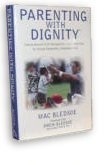
Mac's first book, "Parenting With Dignity", is a sincere and compelling approach to teaching parents how to instill a sense of responsible decision making in their kids. In this book, you will discover a simple premise of the Parenting with Dignity philosophy, and...
See why John Stossel of ABC's 20/20 says this is a must read.
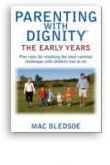
"The Early Years" is Mac Bledsoe's newest parenting book...available in soft cover. Learn the five rules for resolving the most common challenges with children two to six. The perfect companion to Mac's other book and videos below.
Order your copies here and Mac Bledsoe will personally sign them FREE - (makes a great gift for every parent). Shop ahead for upcoming births, birthdays, and the holidays.
Top
Since Drew Bledsoe, a wealthy celebrity, sponsors the foundation, why do you have a non-profit foundation to raise money?
That is a very good question and one that we hear often. Drew and his wife Maura, committed to this cause five years ago with a donation of $1,000,000.00, intended to last six years. Now in our fifth year, they have given this foundation almost twice that that amount. Although they are as committed as ever to this cause, we have grown beyond their solitary means of supporting this program.
Please help us to prove that Americans will support a cause like this. The long-term success of this program is based on grass roots efforts from people like you. We believe that is the best way for us to build a solid financial base. We need your help. Please donate a few dollars to our foundation's efforts. Help us help America's Kids. Won't you please donate a few dollars today? Click here!
Top
Do you make money from the sale of your videos?
The money we charge for our set of ten videos and the workbook, barely covers the cost of production. When you add processing, storage, and other internal costs, we actually lose money on every sale. We want to keep the price of our videos accessible to as many people as possible, so we do not look at this as a profit center.
Top
Who are the experts that you have drawn inspiration and advice from over the years?
Now, for a list of "Experts" I will provide you with some key sources of information. I must first repeat that the number one source of information that we have used has been the kids we have worked with. Any time that we found something that sounded like a reasonable technique or principle as we consulted an authority or expert, we would not put it into use until we had actually tried it out in a real situation. If it worked for us, then we put it into our repertoire.
Here are some of our key sources: Alden Esping - He was the YMCA youth group leader in our hometown of Ellensburg Washington while I was growing up. He went on to teach in Anaheim California where he was selected High School Activities Director of the year in 1996. He was the first person to expose me to the fact that I could challenge myself to higher performance via goals and personal challenges. He has remained an advisor ever since sixth grade. I put so much faith in Alden because he was using his skills daily to improve life for kids in his school.
John Wooden - He was the famous and successful coach at UCLA where he won an unprecedented 11 national titles and he did it with the most positive teaching techniques. I have read and reread his great book, They Call Me Coach (http://www.amazon.com/exec/obidos/ASIN/0809245914/qid=1008865477/sr=2-3/ref =sr_2_75_3/103-2965758-5815840) and every time I learn something new. He might well be the best teacher that ever lived. I have read his other books and find them to be some of the best stuff that I have ever read about working with people and especially young people. He is a "master hero" to me.
Barbara Coloroso - She is the Creator and author of the program called Kids Are Worth It. ( http://www.kidsareworthit.com/) I have only spoken with Barbara twice and it was on the phone but we have read her books and listened to her audio tapes at length. She is the parenting authority that we admire the most.
James Dobson - He is the founder of the Focus on the Family program. We have read his books extensively and listen to both his tapes and his radio show where he hosts many people who are experts and are doing major work in the field of parenting. (http://www.family.org/) I will say that we have some fundamental differences of opinion with some of his teachings (namely the uses of punishment which he advocates quite extensively) but we find so much wisdom in what he and his guests and coworkers teach.
Buck Minor - He was the Cowboy on our ranch as I was growing up (my father's partner for 29 years of ranching.) Buck was a man of extraordinary wisdom and moral character. You will never find him on a website... I doubt that he has ever sat in front of a computer. He has never written any books but he might be the greatest teacher I have known and the greatest influence on my life as a teacher! He was in a constant teaching and guiding mode and I do not think that he very often gave it much thought. He just taught by his actions and wisdom at every step of the way. He demonstrated that honesty is the best policy by simply making it the cornerstone of his life. "Say what you mean, mean what you say, and then, most important, do what you say you are going to do!" Buck has some of the wisest ideas for working with people stated in the most simple of ways. He said that breaking a horse is a rather foolish idea because you want a mount with spirit. You never want to, break a horse. Rather, what you want to be able to do is to direct that amazing spirit for doing the work that you want the horse to help you do! "It's the same with people ya know," he would say.
Arch Andrioti - He was my Mathematics Teacher, track coach, and assistant football coach when I was in High School. He demonstrated to me that all kids deserve equal dedication by those who teach. It is the responsibility of a true teacher to expend just as much effort with the problem learner or awkward athlete as with the smart or gifted.
Lola Whitner - She is a master teacher that I had the privilege of teaching with for 9 years at Walla Walla High School in the city of Walla Walla Washington. I first went to her for help with grammar since I was teaching English and had little formal training in English (it was the only class I was kicked out of in high school.)
Betsy and Stu Bledsoe - They are on the list for the obvious reason that they are my parents. Mom gave us roots and dad gave us wings. Most of the Messages of Love come from Mom.
Dick and Maxine Matthews - They are on the list for the obvious reason that they are Barbara's parents. Her dad taught us the value of honoring commitments and her mom taught us the importance of service above self.
John Matau - He was my best friend for some 31 years. John might be the best schoolteacher that I ever knew. He was a man that was out living on his own from the age of 12 so he had an unusual empathy for kids from difficult backgrounds. His simple teaching method could be summarized by saying expect the best of everyone and then set up a situation to insure the best chance for that success. John would never lower the bar for any student. However, he would go to the end of the earth to help any willing student to reach the high bar that he set. The other thing that john taught me is the power of laughter in education. Bring your sense of humor with you to the classroom and thing will always work out better... and more education will take place. John, like all great people, would never have been able to make it as a teacher without the support of his wife, Mary, who backed him as he dared to challenge formal education by always building an educational environment that was aimed at the convenience and needs of kids rather than adults.
I could go on with this list for days. Every day we meet new mentors. To stop the list here is to leave off many of the many amazing people who have taught us so much. I will end here because I know of the limits placed upon you in the world of media sound bites. Just know that we have learned from a variety of sources. One note in closing is that we have a bias the says that "a PhD is not positive proof of a person's knowledge of useful information and PhDs do not surround all of the knowledge that is out there. There are some single working moms with no formal education that could teach many PhDs a few really important skills for parenting in the modern world. We listen very carefully to those people also. I thank you for seeing past our obvious lack of a formal PhD.
Top
What can people expect from a Parenting with Dignity session?
Quite simply, what I hope that people will get out of the visit with our Parenting with Dignity curriculum is that, whether or not they want to admit it or not, their children will make all of the big decisions in their lives. I want people to understand that this is an inescapable fact of life because when their kids make almost all of those big decisions the parents will not be physically present to make them for their kids. The question of using drugs (and contrary to what some have fooled themselves into believing, alcohol is the most dangerous drug used by teens in America) will be made by the kids because when the drug is offered the parents will not be present!
Kids will also make the decision about sex. Parents could preprogram their cell phone to dial home on speed-dial and at the moment of decision they will not get a call from their children asking for advice! We want parents to understand that at the moment of making decisions what the kids will use are the ideas in their heads. We want parents to understand that if they have taught their kids some good ideas to use in making those decisions the kids will most likely make good decisions but if they have not taught them the ideas for making good decisions that the kids will use whatever ideas they happen to have in their head at the time, and it will probably be the idea presented by the person attempting to entice them into the action.
We want people to understand that it is much easier to insure that their kids make good decisions if the whole community is involved in teaching some common ideas and that this is very possible if they meet to discuss what is going to be taught. Almost all parents want kids to be honest, drug free, and have a sense of their own spirituality. Most parents want their kids to be compassionate and to exhibit appropriate behavior in a public place. The list is easy to put together but parents must meet to agree on some of these critical issues.
Top
Where is God in your Parenting with Dignity program?
Our program is not about WHAT to teach, it is about HOW to teach effectively - how to teach your values to your children. God is for YOU to put in the program! Our course teaches techniques for YOU to use in teaching what YOU believe to YOUR children.
Top
How can I get Mac and Barbara to speak at my function?
Mac and Barbara Bledsoe speak at functions all over the United States. To see where they are scheduled to speak in the future, view Mac's engagement calendar. To inquire about having them speak at your next function, request a date.
Top
Where can I order the video program?
There are three convenient ways to order a set of videos for your personal use.
- Order online using a secure server, click here.
- Telephone (406) 752-8035
- Purchase orders, please Fax to: 406-752-8037
Top
How can I help this worthy cause?
As an individual and through your company, there are a number of ways you can help us accomplish our mission. The first way that everyone can help is by subscribing to our newsletter and keeping abreast of what we're doing to improve kids lives. Secondly, involve yourself with our other opportunities to help:
-
Make an individual cash donation - "Click here" to donate a few dollars to help defray our costs, make a tax-exempt donation securely online via Network For Good.
-
Corporate donors who wish to sponsor an activity, please contact Mac Bledsoe at (406) 752-8035 for more information.
-
Buy a set of our videos and sponsor a Parenting With Dignity group in your community, school or organization.
-
Buy two or three sets of our tapes and donate them to a PTA, church, school or YMCA of your choice.
-
Shop with our sponsors - We are affiliates of quality companies and receive a commission on sales generated from our links. Whether you need a new computer or a tennis ball, a good book or need to book a trip, click from our page and help support our foundation. (Click here to see our selection of quality stores).
-
Link to our site and help us spread the word about effective parenting skills. (see how to do this)
Top
Where can I find information, or an e-mail address for Drew Bledsoe?
As you might expect, Drew receives quite a lot of "fan mail" sent through our Webmaster or other email links. Due to the overwhelming interest in his career, we will be launching a Drew Bledsoe site in the very near future. We will announce the opening of this site in our newsletter, so if you haven't already, now would be a great time to subscribe.