Lessons 3&4 - Deciding What You Want
< Prev | Home | Next >
Lessons: 1 | 2 | 3-4 | 5-6 | 7 | 8 | 9

To establish expectations for your children's behavior it is first necessary to understand that you do not control your children's behavior directly. They control their own behavior. All we can do is to enable them to use their own amazing abilities to the maximum.
There is only one kind of Discipline …
That is Self-Discipline!
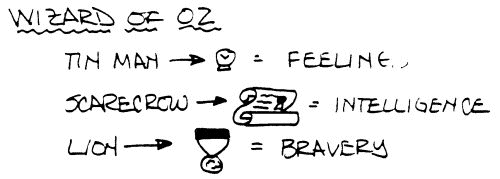
In the story of the Wizard of Oz the young girl, Dorothy, goes off to see the Wizard with the three characters: the Tin Man, the Scarecrow, and the Lion. When they get there the Wizard does his magic and gives the Tin Man a clock to be his heart so he can have feelings. Then he gives the Scarecrow a diploma so he can act smart. Finally, he gives the Lion a medal so he can act courageous.
Then the four of them go off on an adventure in the land of Oz. When they come to situations requiring feelings the Tin Man cries real tears; and when they need intelligent solutions the Scarecrow figures out great ones; and when they need courage; the Lion has developed a real roar!
Then they go back to see the Wizard, who is exposed as an imposter; he has no real powers! But, when all three of the characters needed the power the Wizard had given them, they were able to use it! Where did they get the power? They already had it!
That is a very good lesson for us, as parents, because we are very much like the Wizard. We can not give our children any power they do not already have. All we can do is act as a Wizard to free them to use what they already have.
What kind of a Wizard do you wish to be in your children's lives? A positive one who challenges them to use all of their potential, or a negative one who holds your children back and places limits on their use of their full potential?
Deciding What You Want
Once you have accepted the fact that you have no direct control over your children's behavior and have accepted your role as a "Wizard" in your child's life, then it is time to move on to the next step which is deciding exactly what you want for your children. Once you have a clear idea of what it is you want, your strategy for helping them to use their own abilities to select the desired behavior often becomes very obvious. Let's move on to an understanding of this simple concept.
So often our model of how to work with our children's behavior is to demand obedience. Obedience is, for a number of reasons, a very dangerous control mechanism to use to manipulate a child's actions . First, it is unreliable because, at any time, your child may choose to be disobedient and your efforts will fail. (And it seems the chances of them being disobedient increase proportionately with number of people watching, the danger of the moment, and the patience you are feeling with them at that moment.)
Second, obedience teaches children that they should listen to an "outside voice" to make adjustments in their behavior rather than being self-directed. (Listening to your voice only works when you are present, and as stated earlier, when children make most of their big decisions you will not be there. Having been taught to listen to outside voices in times of decisions, your child will listen to the next loudest voice. Often that next loudest voice is saying, "come on, chicken, try this.").
Finally, obedience does not teach children how to make decisions. It would be a rare child who could actually learn to ride a bike by watching their mom and dad ride one or listening to their parents talk about it. The same is true for making good decisions and choices; kids must be given chances to make choices and decisions! "Put them on the bike"…let them learn to make decisions in the same manner that you would teach them to ride a bike. Give them some guidelines on how to make decisions and then let them make some. If they make a mistake do just as you would with the bike, "pick them up, dust them off, and put them back on the bike with some more guidance on how to ride."
There are a few situations where parents should not simply let kids learn from mistakes. If the behavior is 1. illegal, 2. immoral or 3. life threatening a parent must act as the adult in the situation and intervene. If a child makes that type of mistake the risk is too high and the stakes are too great, thus it may require a much more invasive technique of intervention and protection. The best policy is to stay in the prevention mode and help them to make good decisions before the fact, so that they don't get into illegal, immoral or life threatening situations in the first place.
So, as parents, let's approach the job of teaching children to make good decisions from the point of view that we are attempting to "crowd out" obedience as a method of behavior control. By having some other much more reasonable goals for behavior control you will teach your children to be increasingly self-directed and self-reliant, and you will have killed two birds with one stone. Your children will have reasonable limits on their behavior and they will be growing in their ability to make good decisions; good decisions they will continue to make even when they are out of your presence. So let's explore some other, very valid reasons for asking your children to make decision to limit their behavior, other than your own request or demand for obedience:
- RESPECT FOR AUTHORITY - "Do it because society says so in formal ways." Start at the earliest of ages teaching your children that a civilized world will always have rules and laws. Teach them these rules and laws are not an annoyance; they are an aid to us all. Rules and laws protect our rights, privileges, property, and even our lives. Explain to them the chaos that would result from a society without stop signs, property laws, and rights to privacy, opportunity, expression, and freedom from injury. (A note is necessary here that it is almost impossible to teach respect for laws, and rules if your children watch you violate those same rules and laws! You can't speed and then demand that your children drive the speed limit.)
- APPROPRIATE BEHAVIOR - "Do it because society says so, in less formal ways." You won't be fined or sent to jail for violating any of these rules but many times they may be just as important to obey. These are rules which may often fall under the category of manners, or social customs, but they may be the standards by which your children's character is judged. Teach them that they can act in any way they wish, but other people retain the right to their own response. And... most people's responses can be predicted by these rules.
You can cut your hair in a Mohawk and die it orange if you wish but just remember that many people will then discount you as a meaningless person. It may not be right for them to do so, but it is very predictable. The same goes for conduct in a public place… loud and boisterous behavior in many public places will, very predictably, be viewed as immature and will be looked down upon by many adults. Wearing a baseball cap at a funeral will be judged by most as being an extreme sign of disrespect to the deceased. If you insist upon wearing one to make yourself more comfortable, then it is very predictable that you will be called a disrespectful person.
- HELP - "I can't do this without your help!" Many times a simple request for help will work wonders as a limit upon a child's behavior. Think about it . . . when you ask your kid for help you are sending a couple of very important messages. First, you are saying, "You are a very capable person. Look, I'm giving you an important task to do!" Next, you are saying, "You are a trusted person because this job requires that I trust you." Then, you are saying, "I need you, and my life would be extremely difficult without you and therefore I have come to you, of all the people I know, to ask for help." Finally, you are saying, "A family is a place where we all participate simply because we need each other!" Don't be surprised if your child starts to turn to you in times of stress and need soon after you have modeled that behavior for her/him.
- PEACE - "Do this simply because it will make your life much more peaceful and pleasant." Sometimes things that may seem very basic to us must be explained in detail for our children. For example, "Did you know that people who smile meet more happy people? So, if you would like to spend more time around other people who are laughing and happy then you need to smile, a lot!" Point out to them the many instances in life where cheerful people are given preferential treatment and make it a policy to reward cheerful behavior in the home as early as possible. Let them experience, at the earliest age, their cheerful attitude gets much more attention and results. Make your home a peaceful place by practicing what you preach. Model cheerful and polite requests for compliance rather than angry demands and watch their behavior match yours. (Children learn far more from our actions than from our words. "Do as I say not as I do," may sound nice but it seldom works.)
- PRACTICALITY - "This job needs doing... by you." One of the most hirable skills in the world today is the ability to see a job that needs doing, then being able to figure out a way to do it efficiently... and then DOING IT. Give this ability to your children by giving them jobs to do (simple at first) and then getting out of their way and letting them do the whole job, start to finish. As they complete the job let the satisfaction of completing it be the payoff. It will not even be necessary for you to offer lavish praise. A simple statement from you like, "Nicely done, you did that complete job without any help. Doesn't it feel great to do things on your own? It buys you a big bunch of respect and it buys lots of freedom to do things on your own because then others do not feel the need to check up on you."
- DECISION MAKING - "You have a choice to make; what are you going to do?" This should be started as early as possible. "Which pair of sox do you want to wear?" Then start handing them bigger and bigger decisions to handle, like "here's the map. Which route do you think we should we take?" Next time ask, "Now that you have picked the road to travel what time should we leave?" Later you can seek their advice on tough personnel issues that you bring home from work. Then give them $50.00 and ask them to buy five days worth of groceries with it. Follow with bigger and bigger jobs and bigger and bigger decisions that go with them. Continually ask for their opinion about issues that surround you in life. We learn to make decisions by making them. Like was said earlier, "put them back on the bike!" When they make a bad decision, don't punish them. Tell them that you admire their courage for making the decision in the first place, then ask, "What did you learn from that decision? What are you going to do next? How do you think that will work?"
- LEARNING - "What can you learn from this? Life is one big lesson." Learning could almost be the goal for any adjustment in a child's behavior. When your goal is learning, the strategy often is spelled out right in front of you. Remember, very little is ever learned when anger is involved, either on your part or on the kid's part. Buck Minor the cowboy on our ranch used to always say "when you teach an animal a lesson through anger and meanness, don't be surprised if the meanness and anger are learned better than the lesson. "When learning is the goal anger should never play a role. If either you or the child has become angry it is probably best to wait until the anger has passed to attempt the learning.
"Here is how the world works, and it will help you greatly if you understand this." Often, taking the time to teach is the longest and most difficult way to change your child's behavior, but it winds up being the best way because it results in lasting behavior change. While driving in the car it is quicker and easier to simply separate fighting or quarreling children than it is to teach them negotiating and compromising skills. However, in the long run, separating them really winds up teaching the exact opposite behavior from what seems to be the logical goal.
Separating them teaches them that when people disagree, the desired response is to separate. (No wonder we have such high divorce rates!) With learning as the goal, it would be much more logical to approach two fighting kids by teaching them some effective ways to deal with quarrels and disagreements that will serve them for a lifetime. It takes planning, thought, time, patience, and lots of care to teach negotiating skills and to teach the skills of compromise.
If you, as the parent, choose to make learning your goal, it may take longer to bring about the desired behavior change at age four. However, when you do take the time at age four to teach some skills, then at age fifteen you no longer have to deal with fighting because at that point what you taught at age four will still be working because your child learned it!
Remember, at this point, that you can never assume that a child has learned anything until they use it in the appropriate context to bring about positive change for themselves. Also, it is true that "saying something" rarely defines teaching. So often we hear parents say, "I told him. I don't know what's wrong, but he's not doing it!" Telling does not constitute teaching. If teaching is the goal then a change in behavior must be the measure of the success of your method. You may never assume that you have taught a concept until the child's behavior changes.
If you use one strategy to teach some concept or action and the child does not change, keep the anger out and remember three key words: THAT DIDN'T WORK! Then, try again with another repetition or a completely new method; but don't give up. You may not succeed on the first few tries but one thing is guaranteed... if you stop trying to teach you will fail. Too many parents are willing to say, "I have tried everything," after a few failures instead of simply saying, "Oops, I just found another way to teach this that didn't work, so I had better look around for another way!"
Once you have used these other goals as the reasons to ask your children to make decisions to limit or change their behavior, it is seldom necessary to ask for obedience. Then when you do ask for obedience it can be saved for those few times when obedience is necessary like when the kid is running for the street and a truck is coming. Obedience is necessary when you cry, "STOP!" at a time like this.
One more thought about obedience before we end our discussion. Obedience is much easier to ask for if it is mutual. It will be much easier to get obedience at those critical times if your children can ask for your obedience upon occasion and get it.
Assignment Sheet – Lessons 3 & 4
- Identify another behavior in each of your children that you would like to have them exhibit. This, again, may be something that the child already does and you wish to replace it with a new and more productive behavior, or it might just be something that you would like to see your child adopt. Describe the desired behavior in detail here. (If you are attempting to eliminate a particular behavior describe it in detail also.)
- Now, go to your notebook handout for Lessons 3 & 4 and look at the list of possible reasons to ask your children to behave in the manner that you wish. Now ask yourself a few of the following questions: What do I want my kids to do? What is my goal in asking them for this particular behavior. Do I want respect for authority? Do I want my children to learn to make decisions? Do I want my kids to have more peace in their life? Do I want them to select a more appropriate behavior? Or do I simply need their help? Write down a detailed description of your goal in asking for this adjustment of behavior.
- Now comes the time for you, as the parent, to do some very careful thinking. Now you must devise a strategy for accomplishing your goal that you selected in #2. Your strategy may require that you use three of the Five Rules that you were working with in our last session (Lesson 2), or your strategy may require that you use only one of those rules. Maybe you need to dream up a completely new strategy.
- Keep a daily record of your actions, your child’s actions, and any observations that you have as you go through this process for a week. Remember to record both positive and negative actions, reactions and observations.
- Come to the next class prepared to discuss what took place in your family over the week. In this space make notes of comments that you would like to make comment about at the next class meeting.
Please keep in mind that the purpose of these exercises is to maximize the number of positive and productive ideas that are stored in your mind and the minds of your children. In order to do this you must actually try to structure effective thoughts in your own head as you plan strategies. Then you must observe the resulting behavior in your children. Remember that unless your child chooses to tell you what ideas are in their head, the only way you have of knowing what ideas are stored in their head is by observing their behavior; so pay close attention.
A big part of this process involves not only creating positive change, but also observing strategies that did not work and then devising new and better ones that will work. So, as you go through this process do not be the least bit hesitant to list things that did not work! Remember three of the most important of all words for parents: "THAT DIDN'T WORK!" When you find something that doesn't work STOP doing it and try something else! Sometimes our best teacher is a mistake. Remember that one of the best teaching methods is REPETITION but remember to try to say it a different way! The only time a mistake is counted as a failure is if you let it be the last time you try.
Also, when you try something that doesn’t work remember the important phrase: "keep the anger out!" Anger rarely results in productive thought processes and effective action.